
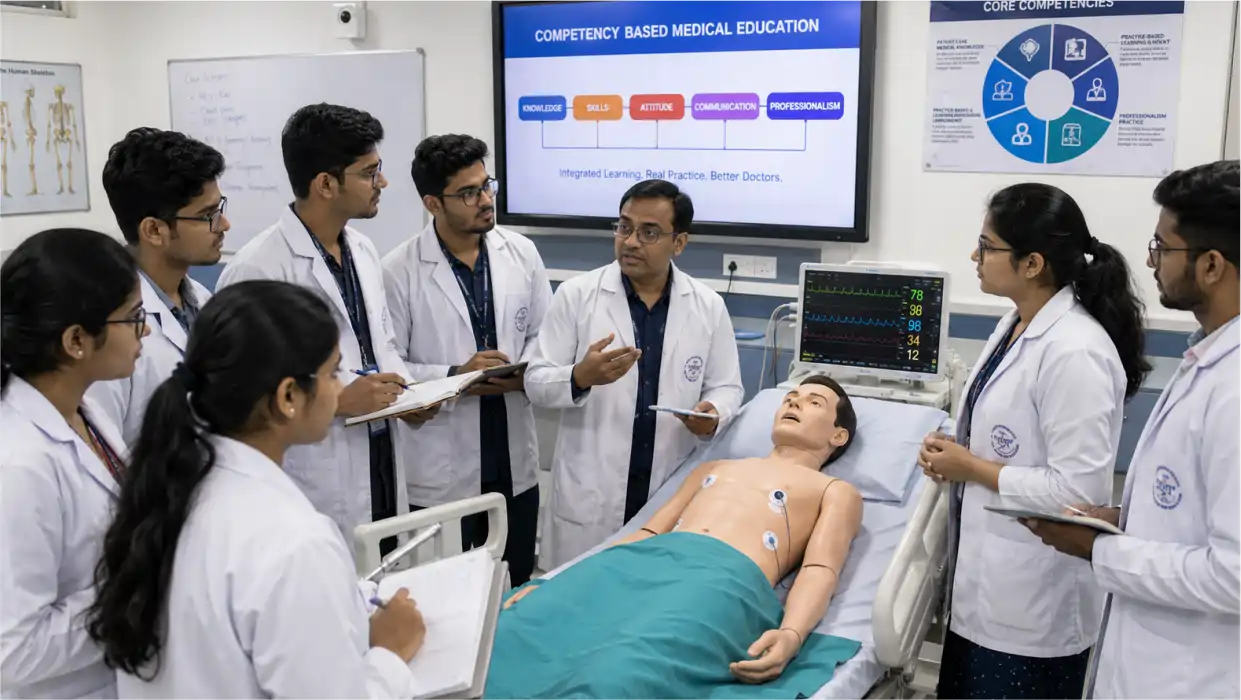
Ask an older doctor how they trained and you’ll hear about subjects completed, hours logged. Ask someone who graduated recently, and you’ll more likely hear about specific competencies could they take a history properly, perform a procedure safely, stay clear-headed under pressure? That shift has a name: Competency-Based Medical Education, or CBME, and it’s changed how MBBS gets taught and assessed.
What CBME Actually Means
CBME moves the focus away from time spent on a subject and toward whether a student can actually show a defined set of skills by the end of training. CBME requires direct proof that a student can take a proper history, examine a patient systematically, and handle a specific scenario appropriately, rather than assuming that someone who sat through a full semester automatically acquired the relevant clinical skills. If not yet, they get more focused practice, rather than just moving along because the semester’s over.
Why This Shift Happened
The old model measured input lectures attended and subjects finished and assumed that time spent equated to competence gained. That assumption doesn’t always hold up. Two students can sit through identical lectures and walk away with very different real abilities. CBME tries to close that gap by measuring the output directly – what a student can actually do instead of using time as a stand-in for skill.
Key Features of Competency-Based Education
- Clearly defined outcomes, specific, measurable competencies, not vague subject completion
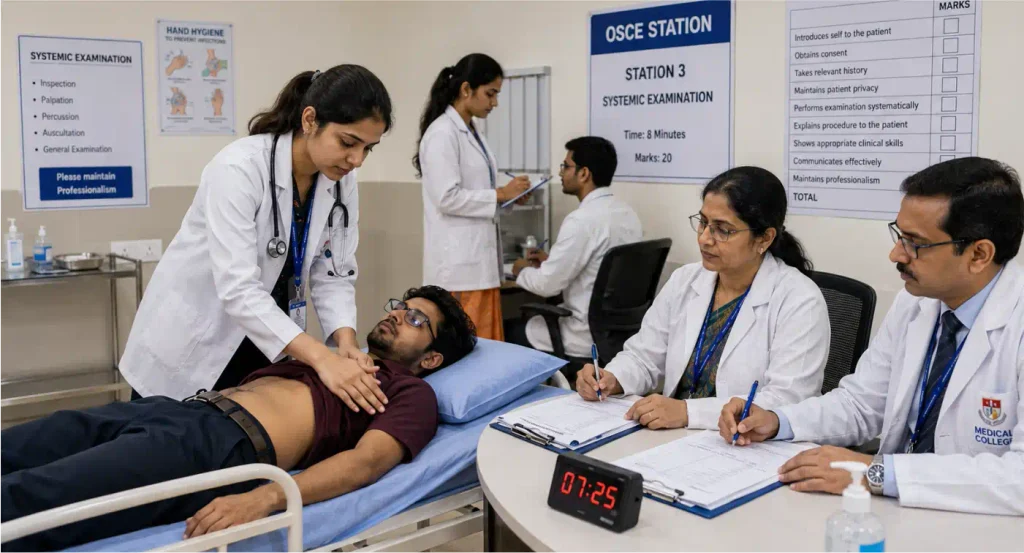
- Direct skill assessment through structured clinical exams, logbooks, and workplace-based checks, not written exams alone
- Early clinical exposure, since competencies build best through actual repeated practice, not delayed to the final years
- Integrated teaching that connects foundational science straight to clinical use, since competencies rarely sit inside one subject
- Continuous feedback throughout training instead of relying only on end-of-year exams
- Attitudinal and ethical competencies alongside clinical ones professionalism gets treated as a skill to build, the same as suturing
How CBME Changes the Student Experience
Under CBME, progress looks less like ticking off finished subjects and more like building a portfolio logbook of procedures done, workplace assessments of patient interactions, and feedback after every posting. Students end up with a clearer, more ongoing sense of where they stand, instead of discovering the gaps only at a final exam. It also requires faculty to observe and assess students directly, rather than relying solely on written tests to estimate competence.
The National Push Toward CBME
India’s move toward CBME reflects the National Medical Commission trying to line up MBBS training more closely with what doctors actually need to do, not just what they need to know on paper. This has meant restructured curricula across colleges, clearer competency frameworks for each training phase, and a much greater emphasis on early clinical exposure instead of two heavy theory years followed by a sudden jump into postings.
Why Choose SIMS HapurWhy Choose SIMS Hapur
Colleges offering medical education in Uttar Pradesh under CBME are expected to build teaching around demonstrable competencies, not just finished subjects, and our MBBS college in Hapur has structured its curriculum with exactly that in mind: proper logbooks, regular workplace assessments, and ongoing faculty feedback instead of everything bunched up at year-end. At the best medical college in Hapur, that means students have a clear sense of where they stand throughout their training, not just at exam time.
Tips for Thriving Under CBME
- Keep your logbook updated as you go, not scrambled together right before an assessment deadline
- Chase down direct feedback from faculty after clinical encounters, that ongoing input is the whole point of CBME
- Don’t treat competency checklists as paperwork; actually work on the skills they represent
- Take early clinical exposure seriously, since CBME assumes you’re building real competence there, not just watching
- Take feedback as information, not criticism, the entire system is built around improving through it
- Ask for clarity if a competency expectation feels vague; knowing exactly what’s being assessed helps you prepare better
Conclusion
What is CBME in MBBS? An approach built around whether students can actually show the skills a doctor needs, instead of assuming classroom hours automatically produce them. Want to know how SIMS Hapur has structured its curriculum around competency-based training? Reach out to our admissions team.