
Introduction
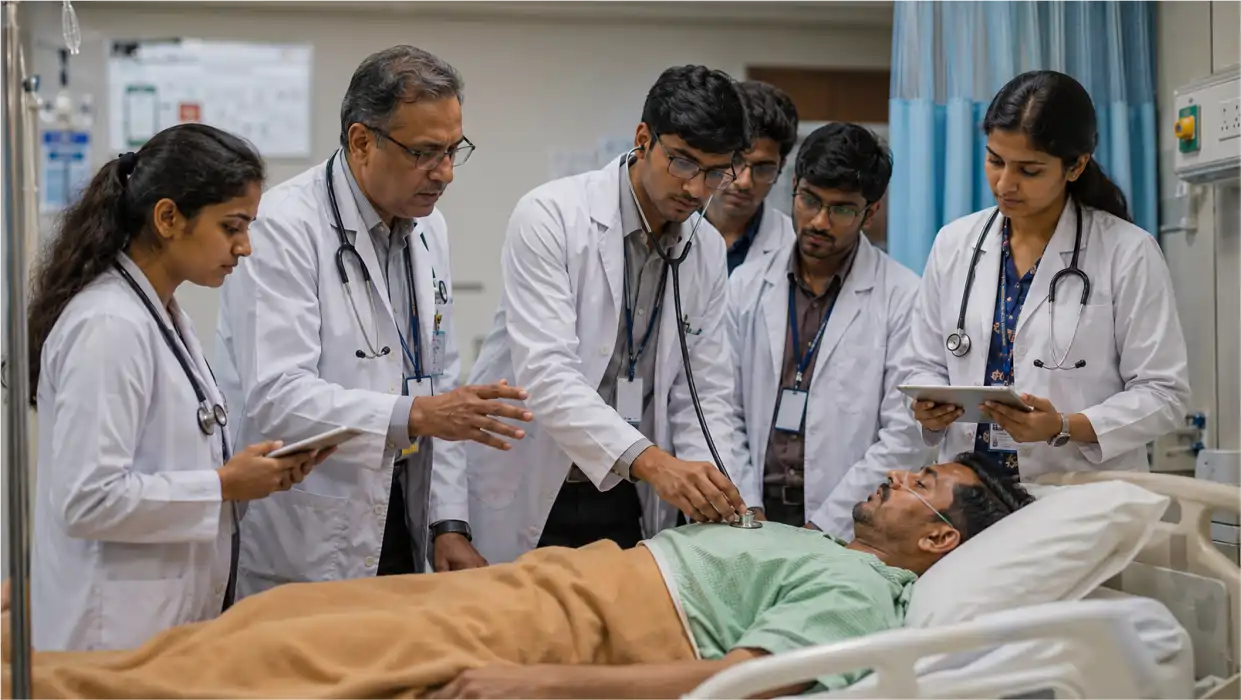
There is a moment every medical internship Hapur student remembers: the first time they stood beside a real patient and realised that nothing they had read fully prepared them for it. The smell of the ward, the anxiety of the patient, and the speed at which an experienced doctor read the room and responded none of it existed in a textbook. That moment is where clinical training begins to matter and why the quality of it shapes everything that follows.
What Clinical Training Actually Involves
Sitting in a lecture hall and understanding a disease mechanism is one kind of learning. Standing in a ward and watching how that disease presents differently in three patients admitted on the same morning is another kind entirely.
Clinical training places students inside working hospitals observing consultations, following patient cases across days and weeks, and participating gradually in examinations and procedures as competence and confidence build. The knowledge acquired through this process does not replace what is learned from books. It gives that knowledge somewhere to land, connecting abstract understanding to concrete reality in a way that makes both more durable.
The earlier this exposure begins to some degree, the more naturally it integrates with everything else a student is learning simultaneously.
Confidence That Comes From Experience, Not Reassurance
A student can be told repeatedly that they will be fine with patients. That reassurance fades the moment they are standing in front of one.
What replaces it, what actually produces clinical confidence, is accumulated experience. The tenth patient’s history taken is less frightening than the first. The twentieth physical examination is more assured than the fifth. Repeated exposure, structured and supervised, builds a quality of readiness that no amount of preparation in isolation can replicate.
Riya was visibly nervous during her first ward rotation. She describes the transformation across her first semester of clinical training MBBS programmes now provide as something that happened gradually and then suddenly, each week slightly steadier than the last, until one day the nervousness was background noise rather than the dominant experience.
Decision Making Under Real Conditions
Medicine rarely presents itself as a clean multiple choice question. Patients describe symptoms imprecisely, test results are ambiguous, and time pressure is constant. The ability to think clearly inside that complexity is not something that develops through study alone.
Clinical environments teach students how experienced doctors manage uncertainty, how they prioritise information, when they act on incomplete data, and how they communicate decisions to patients and families who are frightened and looking for clarity. Observing this repeatedly, and eventually participating in it under supervision, develops judgement that written examinations simply cannot assess or build.
Technology Has Extended What Clinical Training Can Do
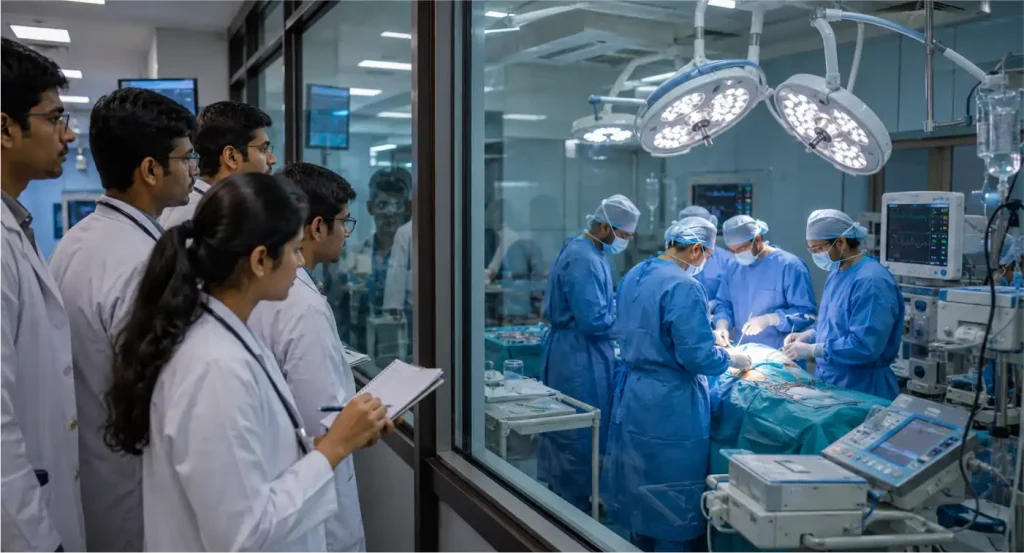
Simulation has added a layer to clinical preparation that addresses something traditional hospital training could not: the ability to practise high stakes procedures before performing them on real patients.
Surgical simulations, emergency response scenarios, and diagnostic decision tools allow students to build physical and cognitive muscle memory in controlled environments. The confidence that follows is not simulated. It is genuine competence developed through genuine repetition, transferred into real clinical settings with measurably better outcomes for both students and patients.
AI-assisted learning tools have also changed how students prepare for clinical exposure medical college encounters, presenting symptom combinations, asking students to reason through differential diagnoses, and tracking where clinical reasoning breaks down before it matters.
What the Updated Curriculum Reflects
The shift toward earlier and more sustained hospital involvement in MBBS training reflects a clear-eyed acknowledgement of what previous graduates lacked when they entered independent practice.
Practical medical education India is now building into degrees reflects this honestly: more ward hours spent earlier, communication skills taught as formal competencies rather than assumed to develop passively, and patient care ethics woven into clinical rotations rather than delivered as standalone lectures that arrive too late to shape behaviour.
Students trained under this model arrive at an internship with a different quality of readiness than those who preceded them.
The Private College Question and Clinical Access
The most important clinical training variable between colleges is not accreditation status or fee structure. It is patient volume.
A hospital that sees high numbers of diverse presentations produces better-trained students than one with limited footfall, regardless of how modern its equipment is. Students evaluating private colleges, including practical medical education India institutions offering internships and similar regional options, should ask specifically about average daily outpatient numbers and inpatient occupancy before any other facility question.
Aman completed his internship at a regional institution and credits the volume and variety of cases he encountered with developing his clinical instinct faster than he expected. The geographic convenience was secondary. The patient’s exposure was the deciding factor.
Where Clinical Training Still Falls Short
Not every college attached to a hospital provides equivalent learning. Low patient footfall limits the variety of presentations students encounter. Poorly structured rotations leave students observing without participating. Supervision that is nominal rather than active fails to build the judgement that genuine mentorship develops.
Students should investigate these specifics during campus visits, asking about rotation structure, supervision models, and patient volume, rather than accepting general assurances about clinical exposure.
Conclusion
Clinical training is not one component of medical education among many. It is the environment in which everything else becomes real.
The quality of hospital training for students a college provides determines, more than any other single factor, the kind of doctor a graduate becomes. Choose a college based on the honesty and depth of its clinical programs. Visit the attached hospital. Ask about patient numbers. Watch how students interact with the wards.
What you observe in those hours will tell you more than any ranking ever could.