
Introduction
Most students approach college selection with a shortlist built around fees, location, and name recognition. Very few walk through a campus asking the questions that actually determine the quality of training they will receive.
Facilities shape doctors in ways that are difficult to measure during admission season and impossible to ignore five years into a degree. Knowing what to look for and what to ask changes the quality of that decision considerably.
Laboratories That Are Actually Used
A laboratory that exists on paper and one that is in daily use by students are two very different things. The distinction matters enormously.
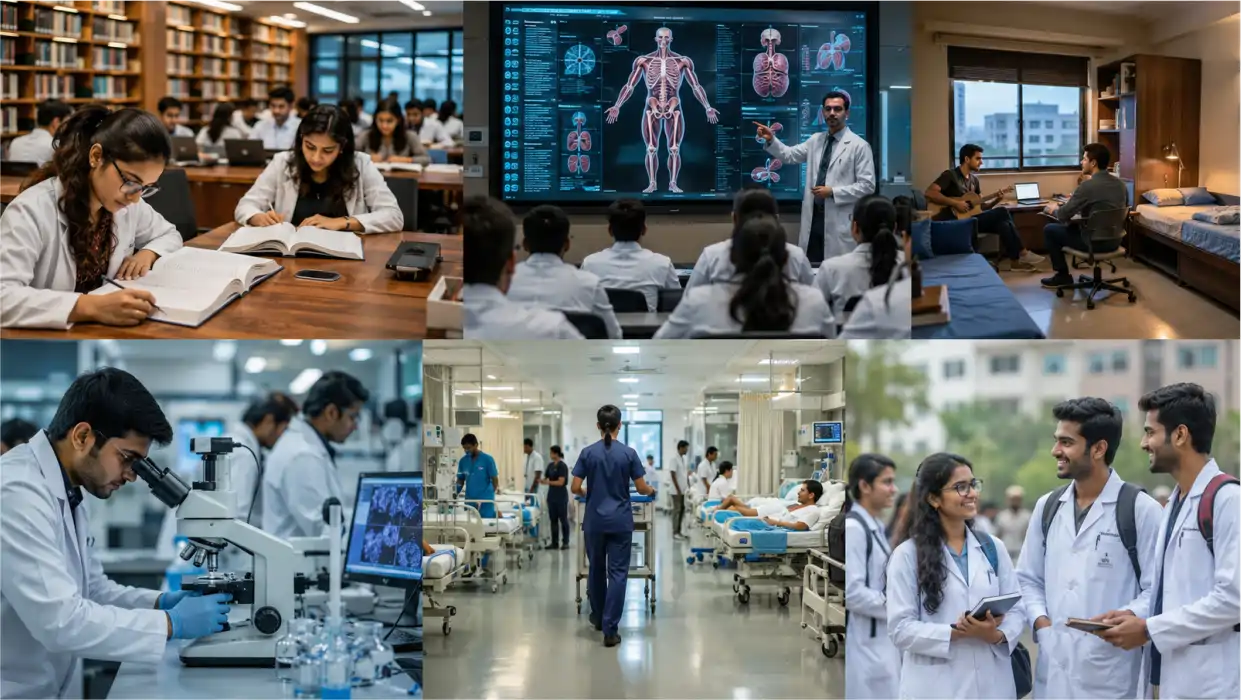
Anatomy, pathology, biochemistry, and simulation labs all serve a specific purpose in building the kind of practical understanding that clinical work demands. A student who has dissected, stained, cultured, and practised in real best labs in medical college environments arrives at clinical rotations with a physical familiarity that purely theoretical training cannot produce.
The question worth asking during any campus visit is not whether a lab exists. It is how frequently students use it, whether access is scheduled or restricted, and whether the equipment reflects current clinical standards or was purchased a decade ago and maintained minimally since.
Neha prioritised lab access when comparing colleges. She visited two campuses and asked to see the pathology and simulation labs specifically. One was clearly in active daily use. The other was clean in a way that suggested it was rarely entered. That observation changed her shortlist entirely.

Hospital Attachment That Delivers Real Exposure
A college attached to a busy hospital and a college attached to an underused one are not equivalent training environments, regardless of what the accreditation paperwork says.
Patient volume determines the quality of clinical learning. A student who sees thirty cases a week across varied presentations develops diagnostic instinct and clinical confidence at a fundamentally different rate than one who observes a handful of routine consultations. The hospital training MBBS students receive is the single most important differentiator between colleges that produce practice ready graduates and those that produce graduates who need another year of experience before they feel competent.
Ravi asked specifically about average daily outpatient attendance and inpatient bed occupancy before finalising his choice. The numbers told him more about the clinical learning environment than any ranking or brochure had.
Infrastructure That Supports Five Years of Serious Study
Smart classrooms, functional libraries, reliable internet, and well maintained hostel facilities are not luxuries. They are the daily environment in which a student must sustain concentration, manage exhaustion, and continue performing at a degree that runs longer and demands more than most undergraduate programmes.
The growth of modern hospital infrastructure India has brought with it rising expectations for what a medical college campus should provide. Institutions that have invested in this infrastructure, not cosmetically, produce students who spend less energy managing their environment and more energy developing their skills.
A campus visit conducted honestly, looking at study spaces at the end of a weekday rather than during an organised tour, reveals more about daily student life than any formal presentation does.
Technology Embedded in Teaching, Not Displayed in Lobbies
Digital tools, simulation platforms, and AI assisted learning systems are now standard features of serious medical training environments. The relevant question is not whether a college possesses them but whether they are embedded into the teaching structure or available in theory and underused in practice.
Colleges that have integrated technology into daily learning produce students who are comfortable with digital clinical tools before they encounter them in actual hospitals. Those who treat technology as a marketing point rather than a teaching method produce students who are surprised by environments they should have been prepared for.
Aman looked specifically at how technology was described by faculty during his campus visits, whether they spoke about it in terms of daily routine or in terms of features and investments. The distinction told him immediately which institutions had genuinely built it into their training and which were still in the process of doing so.
What Private Colleges Have Built
Private medical institutions have moved quickly on infrastructure investment in recent years, partly because newer buildings can be designed from the outset around current requirements rather than retrofitted into older structures.
Institutions across emerging education hubs, including colleges representing medical institute Hapur facilities, have built campuses that reflect current clinical training standards. Students who dismiss regional private colleges without visiting them sometimes discover that the gap they assumed existed between those institutions and metropolitan alternatives is narrower than expected, and in some specific areas does not exist at all.
The Curriculum Has Changed to Match These Facilities
Updated MBBS training places students in clinical environments earlier and keeps them there more consistently throughout the degree. This shift only produces its intended benefit when the facilities to support it exist: functional labs, accessible hospitals, and teaching infrastructure that connects classroom learning to clinical application in a continuous, structured way.
Communication skills and patient interaction are now formal parts of training. This too requires appropriate spaces and structured delivery not an occasional workshop but regular, assessed practice built into the programme from the beginning.
Conclusion
A medical college is the environment in which a student becomes or fails to become a competent, confident doctor. Fees matter, Location matters, but the best medical college facilities list a student should carry into every campus visit, covering labs in active use, hospitals with genuine patient volume, infrastructure that supports sustained study, and technology embedded meaningfully into daily teaching.
Choosing carefully on these criteria produces outcomes that last far longer than the admission decision itself.