
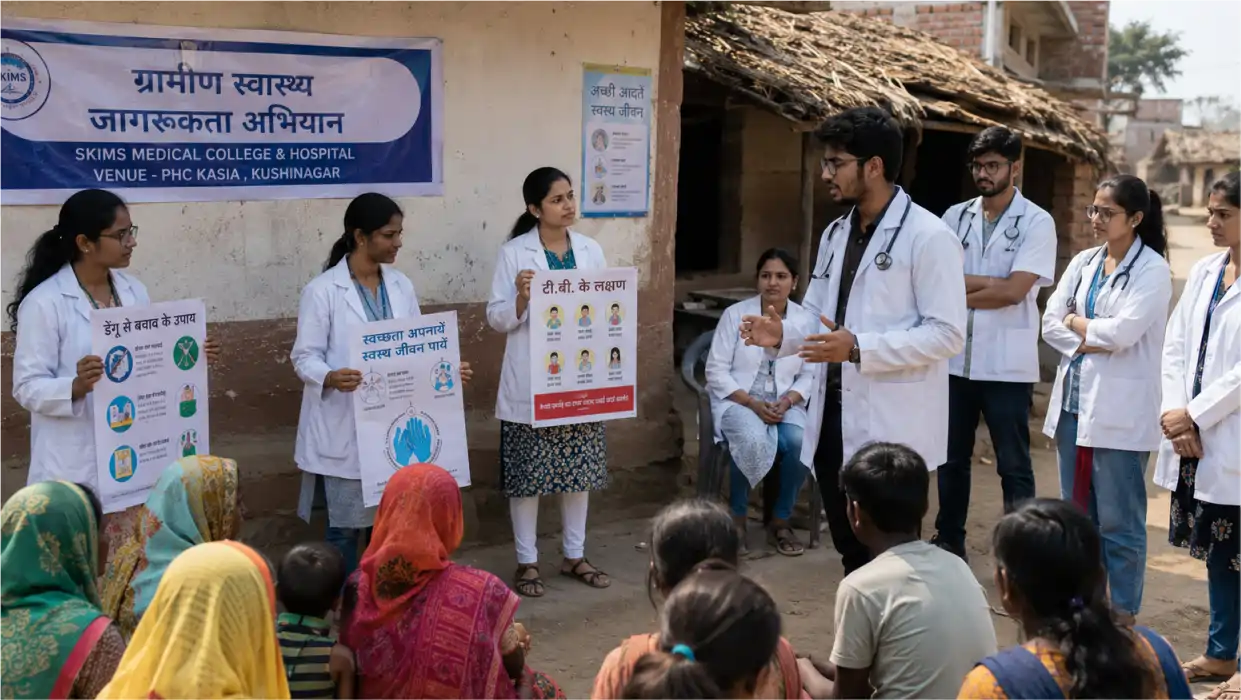
Hospital wards show medicine at its sharpest, most acute moments, but most health outcomes are actually decided outside those walls, through sanitation, nutrition, vaccination coverage, and whether people can even access care in the first place. That’s the space community medicine occupies, and it hands MBBS students a population-level view of health that ward-based training alone just can’t offer.
What Community Medicine Actually Covers
Sometimes called preventive and social medicine, this subject trains students to think beyond the individual patient and consider how disease spreads through a whole population, how public health programmes are designed and rolled out, and how income, education, and access shape health outcomes just as much as biology does. It’s the discipline behind vaccination drives, sanitation campaigns, and maternal health programmes operating at a scale no single clinical encounter could touch.
Why This Perspective Matters for Future Doctors
- It gets students looking at root causes, not just treating the same preventable disease showing up over and over
- Health starts to look like a social issue too, not a purely biological one
- It prepares students for public health roles a lot of doctors take on eventually, alongside or instead of pure clinical work
- It builds epidemiological thinking useful for spotting disease patterns, handling outbreaks, and allocating resources
- Community postings expose students to real social determinants firsthand, which builds a kind of empathy textbooks alone can’t
How Community Medicine Training Works
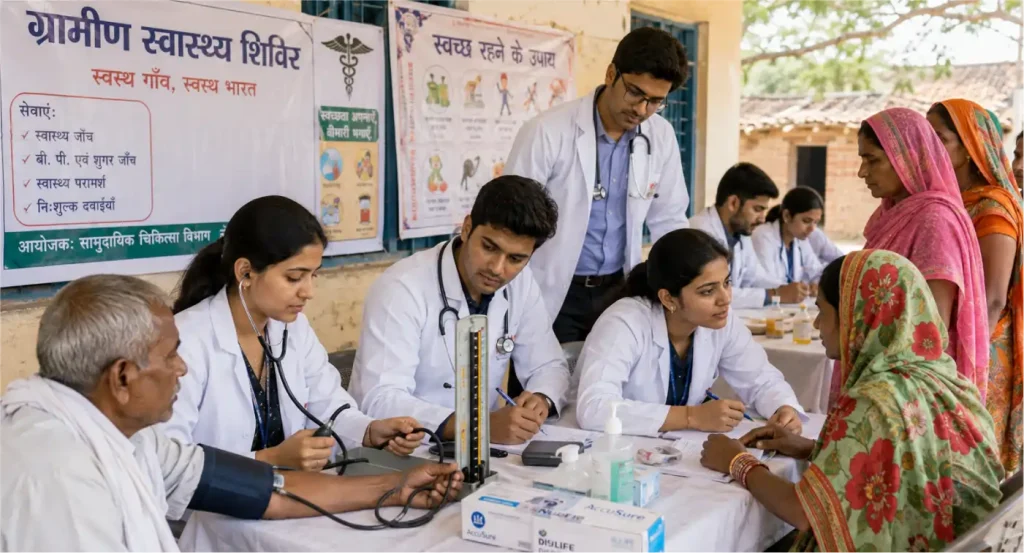
Community medicine training in Hapur usually includes structured rural and urban health centre postings, where students participate directly in immunisation drives, health surveys, and maternal-child health programmes. These postings show students’ healthcare delivery in settings a tertiary hospital never quite prepares them for, often exposing a gap between clinical knowledge and what’s actually accessible or realistic for patients in resource-limited settings, a gap pure hospital training rarely reveals so clearly.
The Broader Value for a Doctor’s Career
Even students headed toward highly specialised, hospital-based careers often find that this exposure shapes their practice years later. A cardiologist who once ran a rural blood pressure camp understands, in a way textbook epidemiology can’t teach, why a patient might skip a medication because they’ve seen the transport, cost, and access barriers up close. That grounded understanding tends to make doctors more realistic about the advice they give, whatever speciality they end up in.
Why Choose SIMS Hapur
As part of MBBS college in Hapur training, structured community medicine postings link classroom public health concepts to real field experience, giving students a genuine sense of healthcare delivery beyond hospital walls. At the best medical college in Hapur, this kind of medical training in Hapur gets treated as core clinical education, not a lesser requirement, with faculty actively walking students through the realities of community-level healthcare.
Tips for Making the Most of Community Postings
- Talk to local health workers during postings, they know things no textbook covers
- Notice the gap between ideal clinical guidelines and what’s actually achievable in resource-limited settings
- Ask how public health programmes actually get implemented, not just how they’re designed on paper
- Connect what you observe in the community back to the conditions you see in the hospital
- Take community medicine exams and postings as seriously as clinical subjects the reasoning carries over directly
Conclusion
Why is community medicine important in MBBS? Because good doctors need to understand not just the disease but the social and systemic context deciding who gets sick and who gets treated in time. Want to know more about community medicine training at SIMS Hapur? Reach out to our admissions team.