
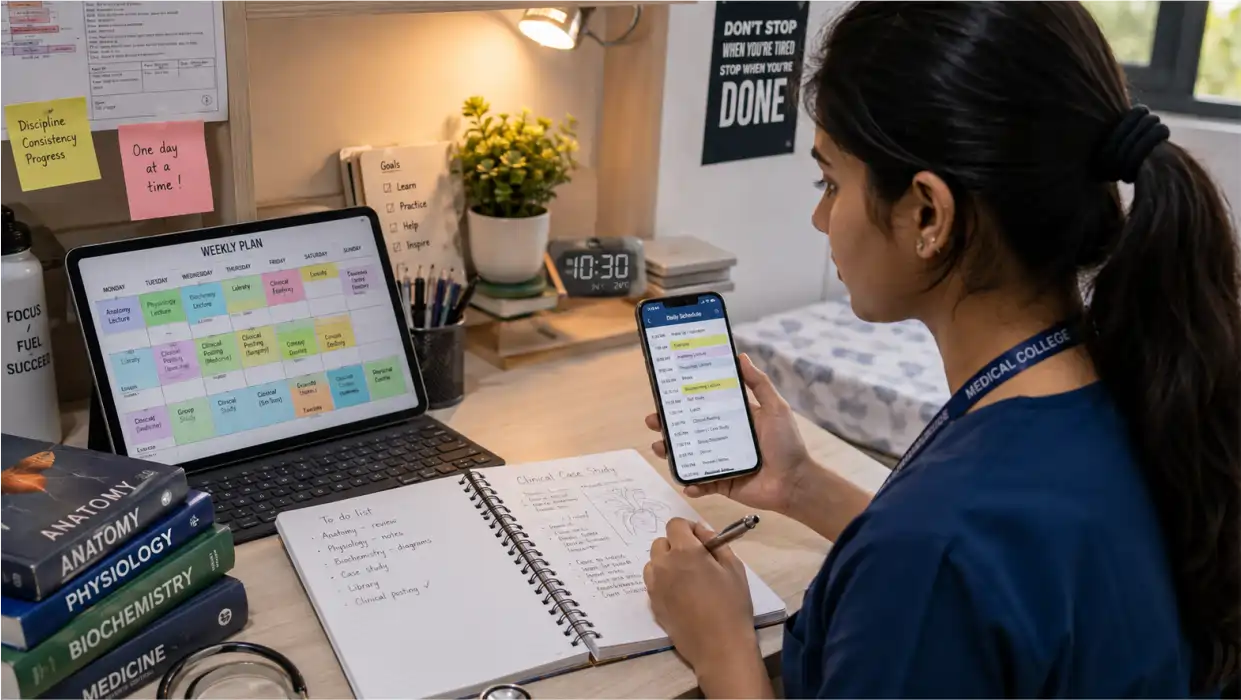
Few courses pile on as much at once as MBBS dense theory, hands-on postings, practical exams, and eventually night duties, all running at the same time. Solid MBBS student tips in Hapur on time management is essential here. They’re closer to a survival skill, and building them early tends to be the difference between manageable and overwhelming.
Why MBBS Time Management Is Uniquely Challenging
Most undergraduate courses give you a lot of freedom to manage your study time. MBBS doesn’t fix clinical hours, unpredictable ward duties, practical exams, and heavy theory syllabi all land in the same week. Without a real system, exam prep gets crowded out by clinical commitments, or clinical learning suffers because a student’s buried in textbooks instead of actually engaging with patients on the ward.
Practical Time Management Strategies
- Plan weekly, not day-by-day, block out fixed clinical hours first, then fit study time realistically around them
- Use active recall and spaced repetition for theory. It retains far better than long, unstructured reading sessions
- Treat clinical postings as study time too, reviewing the theory connected to whatever cases came up that day
- Protect sleep on purpose. Sleep-deprived study and clinical performance both suffer, even if the hours look good on paper
- Build in buffer time before exams instead of assuming the schedule will hold without a single disruption
The Cost of Poor Time Management
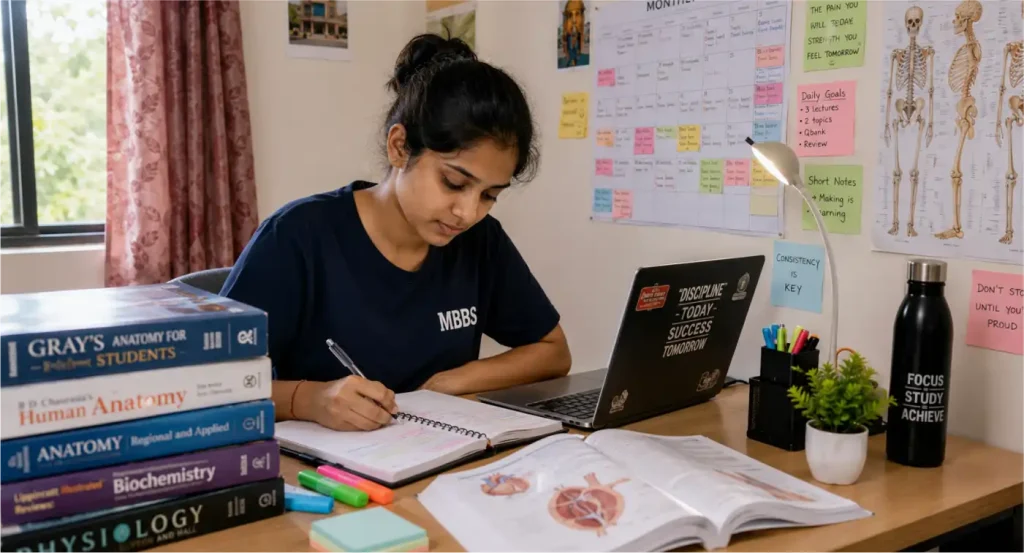
Without a workable system, students end up cramming before exams, chronically short on sleep, and showing up to postings mentally worn out instead of present. That’s not just uncomfortable. It hits learning quality directly and eventually patient safety once a student moves into more independent clinical roles. Treating time management as a professional skill, not just a study habit, tends to change how seriously students take building one early.
How This Plays Out During Medical Student Life
Medical student life in Hapur comes with its own unpredictability, like an emergency admission mid-posting, a surprise practical assessment, or a ward round running late. Students who build some flexibility into their week, instead of a rigid hour-by-hour plan, tend to handle these disruptions without the whole schedule collapsing.
Why Choose SIMS HapurWhy Choose SIMS Hapur
As part of the MBBS course in Hapur, clear academic calendars and posting schedules help students plan more effectively than in less organised programmes. At the best medical college in Hapur, faculty mentorship is also available for students struggling to balance clinical and academic demands, instead of leaving them to sort it out entirely alone.
Tips for Better Time Management
- Set specific daily study goals. “Revise anatomy” isn’t a goal, it’s a vague hope
- Use short gaps between clinical duties for quick review, don’t wait for a large free block that may never come
- Skip multitasking during study sessions, a focused, single-subject study tends to work better
- Build a weekly review habit to catch subjects slipping behind before it snowballs
- Don’t trade sleep and health for study time, both directly affect how well you actually learn
- Reassess your plan honestly every few weeks instead of forcing a schedule that’s clearly not working
Conclusion
How can MBBS students manage their time effectively? Be realistic and plan around fixed clinical commitments, use active methods of studying and protect your time for rest rather than treating it as optional. Want to know more about academic support and student life at SIMS Hapur? Get in touch with our admissions team.